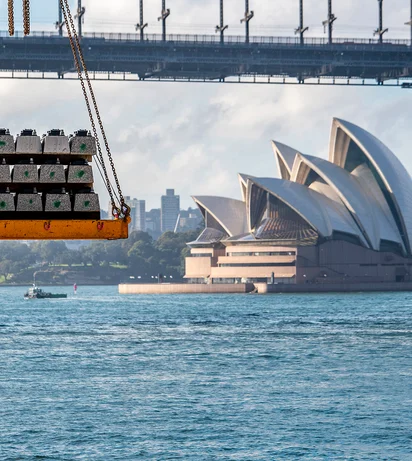
Sydney Opera and Concrete Sleepers

Story | 12/16/2025

Uniting Tracks: Australia’s Journey Towards a Cohesive Rail Network

Australia is a land of extremes which also applies to its rail infrastructure. As one of the largest countries in the world in terms of area, Australia’s main line rail network spans 35,000 km.

Rail transportation is increasingly becoming a preferred choice globally. The combination of ambitious climate goals and the demand for enhanced mobility necessitates a modern rail infrastructure, and Australia is no different.

Australia is a land of extremes which also applies to its rail infrastructure. As one of the largest countries in the world in terms of area, Australia’s main line rail network spans 35,000 km – a length comparable to the total rail network in Germany. Recent data indicates that the Australian rail transportation market reached a value of USD 8.6 billion in 2024, with projections suggesting it will grow to USD 14.8 billion by 2033, reflecting an annual growth rate of 5.95% (2025-2033).

Evolving from local Silos to a National Mission

Australia‘s rail infrastructure has historically been shaped by federal independence. Each state developed its own rail network with different technical standards in the 19th and early 20th centuries. This legacy continues to have an impact today and makes it difficult to achieve uniform rail transport. Furthermore, technical challenges also come into play: long distances through the Outback and extreme climate differences place high demands on materials and operations. Passenger rail has long played a secondary role in Australia’s vast geography, with most mobility centered around Sydney and Melbourne. But that balance is shifting. Driven by sustainability goals, rapid urbanization, and global attention ahead of the Brisbane 2032 Olympic and Paralympic Games, rail is moving to the heart of national transport strategy.

Landmark projects such as Brisbane’s Cross River Rail, the proposed high-speed corridor along the east coast, and the large-scale modernization of Sydney Trains and Melbourne Metro signal nothing less than a new era for Australian rail. Freight infrastructure is undergoing a similar transformation: the 1,700-kilometer Inland Rail project between Melbourne and Brisbane will ease road congestion and redefine the country’s logistics backbone. For providers of integrated system solutions, advanced maintenance concepts, digital technologies, and intelligent signaling, this emerging landscape offers a highly dynamic market with strong political tailwinds and enormous potential still waiting to be unlocked.

Digitalization as a Key Factor for a Sustainable Network

Consistent digitalization is a key lever for modernizing the Australian rail sector. While many systems and processes are still based on conventional systems, digital architectures are currently being developed nationwide to make operations more efficient, secure, and resilient. A particular focus is on automatic train monitoring, intelligent signaling technology, condition monitoring, and traffic management systems. The use of sensor technology, data analysis, and machine learning for predictive maintenance is also increasing. To ensure the longevity of the infrastructure, especially under extreme environmental conditions, solutions such as digital switch monitoring or temperature and load sensors are essential.

Cities Are Booming – Rail Must Lead the Way

Australia’s major cities rank among the fastest-growing urban regions in the Western world. Melbourne, Sydney, and Brisbane must balance population growth, rising commuter volumes, and strict climate goals. Public transport – and above all rail – is set to become the structural backbone of sustainable urban development.

Sydney Bets on Rail: Metro Expansion Instead of Gridlock

Sydney Metro is Australia’s largest urban rail initiative: a fully automated, high-capacity network that will span 113 kilometers once complete. It will ease pressure on existing suburban rail and bus systems while linking key residential and business districts. The City & South West Line alone is expected to boost overall rail capacity by 60%. By 2036, the upgrade aims to remove 20,000 car trips from the morning peak through modal shift. For this project, Vossloh delivered 35,000 concrete sleepers – engineered for a 120-year service life.

Rhythm in the Tunnel – How Melbourne is picking up Speed

In Melbourne, meanwhile, the Metro Tunnel which opened on 30 November 2025 creates a new underground backbone for local transportation. It connects previously separate lines and creates capacity for additional trains running every minute. Right in the middle of this project:  Vossloh‘s engineering services and customized superstructure solutions for the rail tracks, which have significantly reduced noise and vibrations thanks to our highly damping rail fastenings. 

And the story continues: Brisbane is seizing the momentum of the 2032 Olympic and Paralympic Games to push its rail ambitions even further. The Cross River Rail – a 10.2-kilometer north–south corridor with four new underground stations – is designed not just to ease pressure on the city center, but to reshape mobility across the entire metropolitan region for decades to come.

What unites these flagship projects is a shared ambition: expanding public transport not only in capacity, but in quality. Smart station design, high train frequencies, effortless transfers, and fully digital passenger experiences are quickly becoming the benchmark for modern urban rail. For technology providers, construction specialists, and operators, this shift opens up significant new opportunities in one of the world’s most dynamic rail markets.

Melbourne Metro Tunnel

Why Vossloh is investing in Australian Production Facilities

Vossloh works for nearly all major network operators worldwide. Local customer proximity and investment are fundamental in this regard. Thanks to our unique focus, we can manage all relevant market segments in Australia – from the requirements of high-speed transportation to the extreme demands of heavy-load rail transportation. One example: The Australian rail network has the highest axle loads in the world, and we have been a leader in developing solutions for these extreme conditions. 

Bendigo Production Site_Inside

From Gold Rush Roots to Engineering Excellence: Bendigo’s Evolution in Modern Switch Systems

Bendigo is one of the most historically significant places in the Australian state of Victoria which is best known for its 19th-century gold rush and the still-visible heritage architecture from that era. The city blends its colonial legacy with a vibrant arts and cultural scene, shaped by the Bendigo Art Gallery district and the historic tram lines that remain iconic features of the region.

In February, the new production facility for Vossloh turnouts in Bendigo was opened, representing a significant investment in local manufacturing and the future of the Australian rail network. The new facility is part of the Business Unit Switch Systems, one of four globally operating business units focusing on the provision of "under the track" solutions. More than 250 hundred days after the opening, Boris Rozentoul, Managing Director of Vossloh Switch Systems in Australia draws a positive conclusion: “Our new facility sets a global benchmark for precision, automation, and sustainability in the production of turnouts and other essential components that ensure the safety and reliability of the rail network. This enables us to more than meet the demanding market conditions in Australia and serve our customers who have already visited the site in large numbers in a future-proof manner.” The new facility supplies critical infrastructure for projects in Victoria, South Australia, New South Wales, and Queensland. With 200 experts at six locations, Vossloh is well positioned to support major projects, including potential high-speed rail projects. “By investing in this location and strengthening regional jobs, we’ve created something our whole team is proud of and that makes me personally proud, too.”

Bendigo Production Site_Bird View

cangaroos near production site; by Boris Rozentoul

Cangaroos_Bendigo