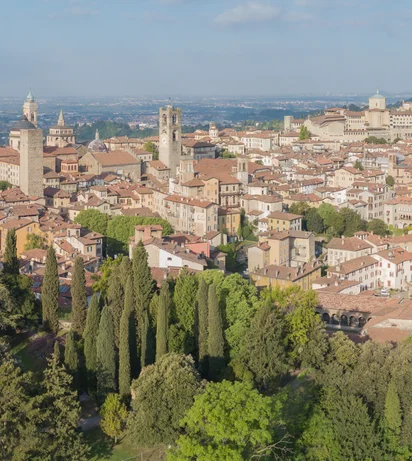

Between the Seriana and Brembana valleys, the surrounding communities and the vibrant city centre, a mobility system is currently taking shape that is attracting attention far beyond the city itself. The first tram line, T1 towards Albino, demonstrated how a disused railway corridor can be transformed into a high-capacity, comfortable and popular means of transport.

Bergamo’s new T2 line to Villa d’Almè adds a second axis to this story, one with an equally distinctive character. Where trains of the former Ferrovia della Valle Brembana once ran, a modern tram connection is now being built, linking five municipalities – Bergamo, Ponteranica, Sorisole, Almè and Villa d’Almè – over a route of 11.5 kilometres and connecting the daily lives of more than 240,000 people more directly to the city.

In its first section, T2 uses T1’s existing urban corridor: from Bergamo FS station via Borgo Palazzo and San Fermo, both lines will in future run on the same track. This creates a shared backbone section that brings together rail, bus, tram and the future airport connection to Orio al Serio – a genuine mobility hub that is far more than just a stop. From the new Bronzetti interchange stop, T2 branches off towards the Brembana Valley. From there, it follows the former railway alignment almost in its entirety, a corridor that lay unused for decades and is now returning as a green, rail-based lifeline. Seventeen stops are planned along the route: nine in Bergamo itself, and two each in Ponteranica, Sorisole, Almè and Villa d’Almè.

A defining feature of the project is its consistent focus on a dedicated, protected right-of-way. Around 95 per cent of the route will run on a segregated track bed, with 23 crossings for cars, pedestrians and cyclists. This not only ensures reliable punctuality but also reduces conflicts within the overall transport system – a key factor in everyday attractiveness. Technically, T2 includes several notable engineering structures: a new tunnel at Pontesecco, upgraded bridges over the Morla, Quisa, Rigos and Rino waterways, as well as the refurbishment of the historic Ramera tunnel, which will remain the only single-track section and thus preserve a visible piece of transport history within the modern operation.
Alongside the tracks, an almost ten-kilometre cycle route is being created from San Fermo to Villa d’Almè. It will link the new tram stops with the existing cycling network, run alongside the Parco dei Colli, and brings to life in a very tangible way what is conceptually known as ‘intermodal connectivity’: reaching the stop on foot or by bike and then continuing by tram. Bergamo is also thinking ahead operationally: ten new vehicles, each 33 metres long and with capacity for up to 281 passengers, will strengthen the existing Sirio fleet on Line T1. Together, the system will then have 24 vehicles available for use across both lines – an important foundation for a peak frequency of six to seven minutes and robust operational reserves in the background.

Clear local transport goals for lower CO2 emissions
The goals are clearly defined: from 2026 onwards, T2 is expected to carry more than 4.5 million passengers per year, limit travel time between Bergamo and Villa d’Almè to 30 minutes and significantly reduce car mileage in the region. Forecasts point to around 26 million fewer car kilometres and roughly 3,000 tonnes less CO₂ per year. In this way, Bergamo is sending a clear signal in favour of climate-friendly mobility. This pace of implementation is made possible in no small part by Italy’s recovery and investment plan, PNRR (Piano Nazionale di Ripresa e Resilienza). A large share of the roughly 225-million-euro project volume for T2 comes from this programme, complemented by funding from the Ministry of Transport, the Lombardy Region and the city and surrounding municipalities.
Behind this development lies the infrastructure that makes dense, reliable and quiet operation possible in the first place. This is where Vossloh comes into play.
Along the new T2 line – from urban corridors and bridges to tunnels and the new depot at Petosino – the track is exposed to particular demands: high service frequency, short stop spacing, sections with speeds of up to 70 km/h and, at the same time, sensitive urban environments where noise and vibration should be kept to a minimum. This is precisely the interface between engineering and urban space where Vossloh contributes its rail infrastructure solutions.
Depending on the section and substructure, different systems are used, all with one thing in common: they must provide lasting operational safety, remain flexible under temperature changes and load variations, and at the same time dampen vibrations. In tunnel sections such as the modernised Ramera gallery, as well as in sensitive residential and green areas, elastic rail fastening systems help reduce vibration and noise. In a network such as Bergamo’s, where T1 and T2 will in future share one fleet, track availability is crucial: quality in rails, fastening systems and turnouts reduces unplanned maintenance and enables the operator to maintain dense service frequencies.

Green mobility with a systemic understanding
Vossloh’s commitment in Bergamo is shaped by a view of the entire life cycle of the infrastructure – from planning and construction through to long-term operation. The ambition is clear: extended maintenance intervals, optimised maintenance strategies and therefore lower total operating costs over decades.
To meet this ambition, Vossloh combines a range of system solutions and services in Bergamo. These include grooved rail turnouts, the EPS composite sleeper, and the W14 and W-Tram fastening systems. Chamber filler elements for the functional design of the track space are added, alongside transition rails and grinding and welding services that help secure long-term track performance. It is precisely this interaction of components, systems and services that makes the difference: it supports reliable operations, reduces maintenance effort and contributes to the life-cycle optimisation of the infrastructure.
From Vossloh’s perspective as well, Bergamo thus forms a coherent picture: a city with historic substance and Italian flair that is rethinking its mobility. A city with rail infrastructure that ensures the tram can function reliably as the backbone of this system, day after day.
