Vossloh

Trailblazer of Green Mobility

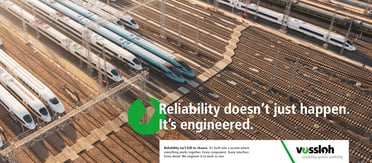
Sustainable mobility depends on rail infrastructure that remains safe and available over decades. Vossloh contributes to the operational reliability of rail networks worldwide by focusing on the system as a whole – from components and digital interfaces to services along the track. Our standards, systems and technologies are designed to support reliable, safe and loweremission rail operations. In the context of aging infrastructure and rising demand, this system view becomes a key prerequisite for real progress.

In the rail sector, Vossloh offers solutions for the entire track: from fastening systems and concrete sleepers to switches and rail services - combined with digital expertise. This broad and integrated approach is why we see ourselves as trailblazers of green mobility – we help create the structural foundation that makes green mobility a reality. 
Rail infrastructure is a long-term responsibility

When construction ends, the real challenge begins. Rail lines must perform day and night, often for many decades, and they do so under increasing traffic, higher speeds and growing expectations for punctuality. Across Europe and in many other regions, networks are reaching their capacity limits while infrastructure is aging. Visible progress is therefore not just new lines, but existing corridors that continue to operate reliably despite these pressures. 

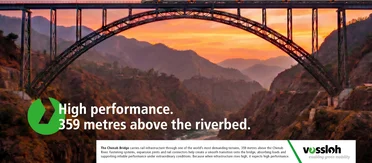
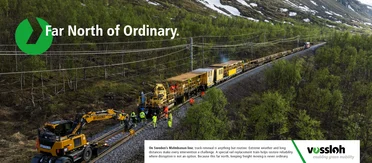
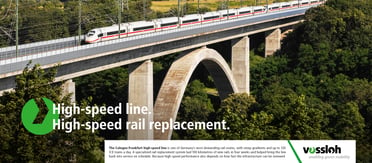
Behind this performance are countless details that usually remain unseen. Vossloh links components, services and data into systems that support every phase of the lifecycle – from installation to condition-based maintenance. Our solutions are developed to enhance safety, durability and efficiency over time. The overall system only works because these details are precisely aligned to set and maintain the right pace, as proven in reference projects in different countries and operating conditions. 

Sustainable mobility starts beneath the train

Trains can only be as sustainable as the infrastructure they run on. The foundations of green mobility lie in the track: in the way rails, fastenings, sleepers and switches are designed, installed and maintained. This matters more than ever as rail is expected to carry more passengers and freight as a climate‑friendly mode of transport. 

Sustainable mobility has two levels: the visible network of lines and routes, and the invisible level of systems, products and technical details that keep it functioning. Vossloh works on this second level, engineering track systems for long service life, efficient maintenance and high track availability. Reduced wear, optimized service intervals and noise‑reducing solutions support operators in meeting environmental and performance targets. When the fundamentals are right, green mobility becomes a practical reality across the entire rail system – not just on board the train.


Railways are the lifelines of our modern world

In growing metropolitan areas, rail forms the backbone of everyday mobility. Commuters, schoolchildren, and goods all depend on urban networks that are punctual, frequent, and safe. At the same time, many city systems are under strain: increasing passenger numbers, limited space for expansion, and the need to reduce emissions and noise. Reliable rail infrastructure is therefore essential to keep cities functional and livable.

Vossloh supports this by treating urban rail as an integrated system rather than a set of isolated assets. We bring together solutions and expertise from different areas into projects that reflect real‑world conditions: tight curves, mixed traffic, demanding timetables. The result is infrastructure that can handle higher loads with less disruption, while contributing to quieter streets and better air quality. When all elements in the system are aligned, the urban “lifeline” can keep flowing – often unnoticed, but crucial for everyday life.

A coherent system for long-term resilience

Rail infrastructure is planned and built on a timescale of decades. Across Europe and in many other regions around the world, rail networks are increasingly operating with components that are at or beyond their original design life. In this context, it is not enough to focus on delivery and installation; long‑term performance and modernization become central questions.

Vossloh therefore looks at how components interact over time, how they behave under real operating conditions, and how data from the track can be used to intervene earlier and more precisely – based on the actual condition of the track. By linking rail infrastructure products, track information and maintenance competence into coherent systems, individual solutions become contributions to long‑term resilience: higher safety margins, longer lifecycles, and more efficient maintenance strategies. Sustainable mobility depends on both visible results – functioning infrastructure – and the less visible prerequisites in design and operation. The system as a whole can only meet future demand if each detail is engineered with its long‑term role in mind.