overlay

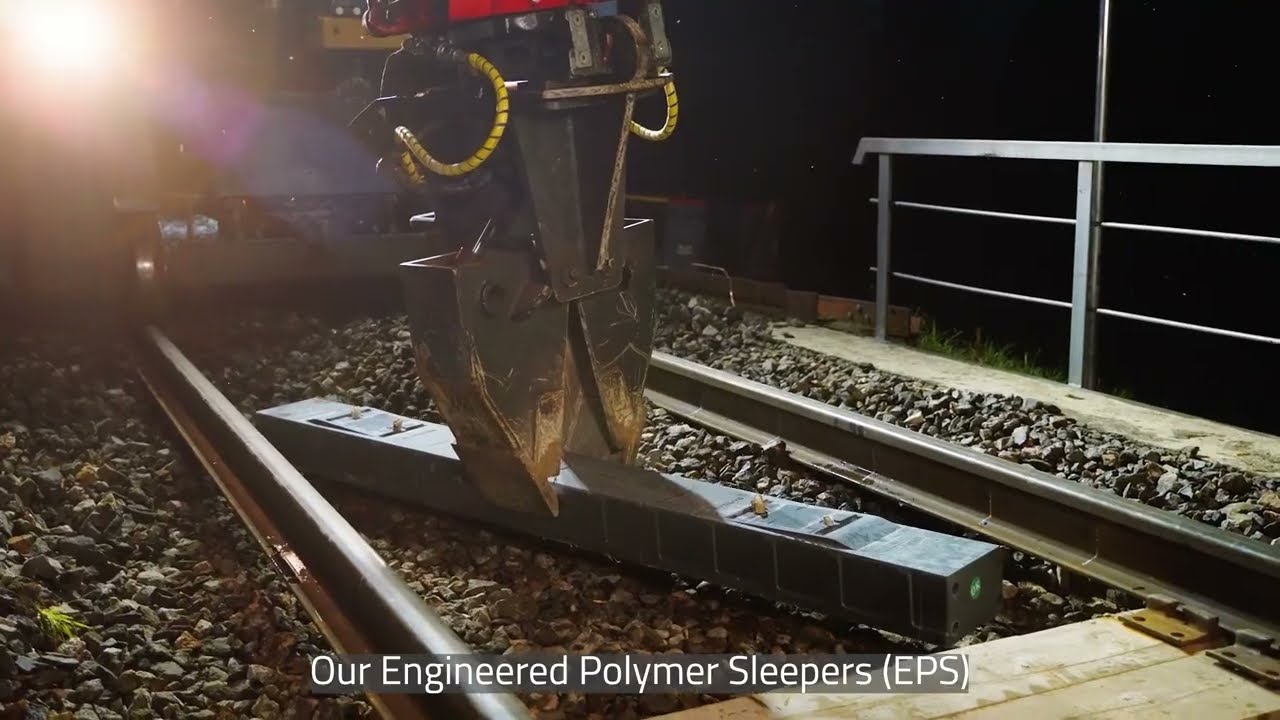
Engineered Polymer Sleeper (EPS) made of amalentic®

More than just an alternative

FLEXIBLE. ENVIRONMENTALLY FRIENDLY. FUTURE-ORIENTED.

Every rail infrastructure project has different requirements. That is why railway sleepers are specially developed to meet the specific conditions of each individual application. As a load-bearing component of the railway superstructure that transfers and distributes loads to the track substructure, the sleeper must fix the rail attached to it in position and thus ensure that the track gauge is maintained. That is why all aspects of the project are taken into account before a new sleeper is manufactured – including operating conditions (axle load, speed), geographical factors (relief, vegetation) and environmental conditions (climate, temperature fluctuations). 


The Milan subway required sleepers that were particularly flat. Measuring only 100 mm in height, EPS meet this requirement and, thanks to their modular tool concept, offer maximum adaptability. For this low-profile solution, a through-bolt fastening was chosen, with the nut integrated into the sleeper.


The modular tool concept makes EPS a bespoke solution for every application. The length, shape, reinforcement and fastening systems can be flexibly selected for conventional routes. This means that the sleeper can reliably cover all application scenarios.  

Production-related design options for a simplified installation process

Starting with the sleeper shape, the positioning and type of reinforcement can also be adapted to application-specific requirements. To increase track stability, profiling on the sides and underside is provided. If slip-resistant surfaces are required, for example, the EPS can be modelled with a rough texture.    

Textured surface with T-groove

Fast-clip shoulder

Time and cost savings thanks to direct fastening 

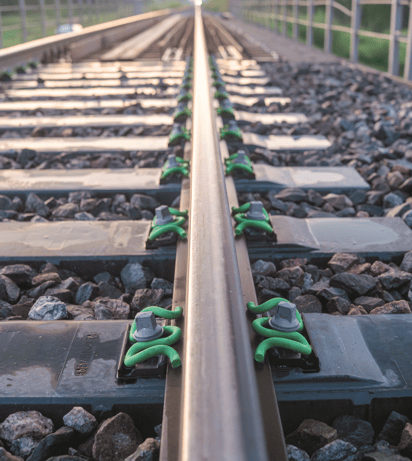
The biggest advantage of EPS is that, in addition to the traditional indirect KS fastening method using ribbed plates, direct rail fastenings can also be used for the first time. Both the trapezoidal corrugation and different inclinations in the rail support can be taken into account when manufacturing the sleeper shape in the production process. Since the sleepers can be delivered with pre-drilled, precisely positioned screw holes — with or without threads — the torque required for tightening is reduced, pull-out forces are increased and time-consuming drilling work on the track is unnecessary. The screw axis can be designed at a 5° angle for direct fastening to make installation easier.  Lower weight of fastening, fewer components, and reduced CO₂ equivalent per sleeper reduce material usage and protect the environment.   

Technical performance: Greater elasticity, subsequent height (+10 mm) and track adjustment (+/-10 mm), and improved load distribution ensure stability and driving comfort.  

Easy handling: Less material and transport costs, reduced master data maintenance, lower inventory levels, and minimized risk of parts loss simplify processes considerably.  

Quick installation: Pre-drilled holes, integrated T-grooves, and pre-assembled fastening systems save time and reduce installation costs.  

Efficient time management: Less reworking on the construction site, faster installation, and reduced downtime.    

Technical specifications that impress


Direct & indirect fastening 
Dimensions   0.16 x 0.26 x 2.6 m  
Weight   170 - 175 kg
Density  ~ 1.55 g/cm³  
Coefficient of thermal expansion 20.1 x 10⁻⁶ K -1 
Modulus of elasticity 5,000 - 6,000 MPa  
Anchoring pull-out forces for standard sleeper screws 

> 70 kN (drilled screw hole)  

> 85 kN (prefabricated screw hole)