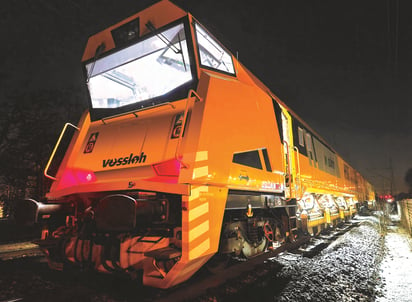
Framework agreement for preventive maintenance extended
DB InfraGO has extended its framework agreement with Vossloh for preventive rail maintenance by another year. Since 2023, around 40 000 kilometers of track on Deutsche Bahn’s heavily trafficked railway network have been machined using High Speed Grinding (HSG) and measurements taken – without a single track closure. That’s the significant contribution this intelligent preventive maintenance is making to track availability on Germany’s rail network.
“Good health requires regular care and that’s also true for rails”, says Imke Kellner, Board Member for Track Infrastructure at DB InfraGO. “Vossloh’s rail maintenance machines help us avoid disrupting railway operations, and that’s why it’s essentially all the passengers and freight customers using the railway who benefit from this framework agreement.”
The work can be done entirely within the normal train timetable. Consequently, over 4800 hours of additional network capacity have so far been gained through the use of HSG technology.
“High-speed grinding has proven its value in the demanding conditions of Germany’s rail network,” says Oliver Schuster, CEO of Vossloh AG. “We are pleased by DB InfraGO’s continued trust and will further develop the technology together to sustainably enhance the reliability of the network.”
Practical experience has shown that a rail’s lifespan can be extended by up to 100% with regular preventive machining. Rail defects are prevented from progressing beyond their early stages, future construction and the speed restrictions required are significantly reduced and noise emissions are lowered by up to ten decibels, as measured on the dB(A) scale adjusted for the human ear.
The work carried out under this contract will be accompanied by an extensive range of Vossloh’s in-house digital developments. They enable partially automated planning, preparation, analysis, and documentation of maintenance services.
These integrated technologies include transverse profile monitoring and correction, longitudinal profile measurements using laser sensors, crack detection using eddy current probes, live schedule views and detailed evaluation to create an information-based, integrated maintenance system.
