Story | 8/12/2026

Curiosity, team spirit, and innovation combine to create the Engineered Polymer Pad

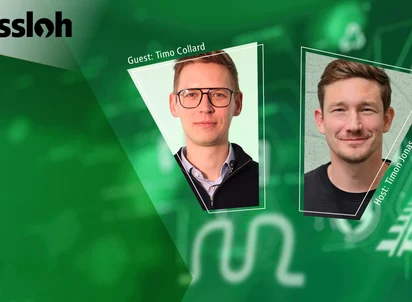
Timo Collard has been with Vossloh Fastening Systems for about twelve years

 – and has worked his way up from a trainee to a product manager. Today, as a member of the strategic product management team, he is responsible for the Composite Materials segment and, among other things, is driving the development and market launch of the Engineered Polymer Pad (EPP). His motivation: to bring innovations to fruition and play a key role in shaping sustainable mobility. 

Taking on more responsibility step by step

Timo Collard is now 32 years old and will have been working at Vossloh Fastening Systems for 13 years in September. His professional career began in the traditional way as a trainee. He then moved to the Business Development department, where he initially worked on areas such as sales controlling and market analysis before gradually taking on more responsibility and assuming the role of Business Development Manager.

At the same time, he invested in his education, earning a Bachelor of Arts in Business Administration and a Master of Science in Sales Management. When a new strategic product management department was established at Vossloh Fastening Systems in Werdohl three years ago, Timo took over responsibility for the Composite Material segment. These now include the Engineered Polymer Pad and the Engineered Polymer Sleeper.


Engineered Polymer Pad: from initial development to market readiness 

Timo's work on the Engineered Polymer Pad (EPP for short) had a particularly formative influence on him. He was already involved right from the start of the development project in 2021. At that time, neither the current product name nor a finalized design for the company's own sleeper pads existed. In his role in business development at the time, he took charge of the development project and, together with an interdisciplinary team, helped shape the new product from the very beginning.

It quickly became clear to him that the EPP should stand out by offering clear added value – above all, through sustainability and long-term customer benefits.

Sustainability as a development goal

EPP is already made up of more than 95% recycled material. Production is powered by green energy, including energy generated by our own photovoltaic system. In addition, at the end of its life cycle, the product can be separated from the concrete sleeper and is fully recyclable.

For Timo, this is a key part of the product’s value proposition: high performance in use, cost-effective over its lifecycle, and resource-efficient at the same time.

Why the EPP is important

In the interview, Timo clearly explains the function that sleeper pads actually serve. It acts as an elastic layer between the sleeper and the ballast. Concrete sleepers have only a very small direct contact area with the ballast stones, resulting in high localized loads. These factors cause the ballast to wear out more quickly, requiring it to be cleaned, tamped, or replaced.

This is exactly where the EPP comes in. It distributes the load across more ballast stones and thus provides lasting protection for the ballast. That is why the first product variant is called Ballast Shield. Beyond that, the product provides additional advantages, such as reducing noise and vibration or improving lateral sleeper resistance, which is an important factor in keeping the track stable under high temperatures and increasing loads.

A product designed to meet the demands of modern networks

Timo clearly recognizes that solutions like the EPP are particularly relevant today, since fewer entirely new routes are being built in many markets, especially in Europe. Instead, existing networks are being used more intensively, modernized and subjected to higher loads. Higher frequencies, increasing speeds, and more traffic on existing infrastructure are placing greater demands on the rail system. The EPP is therefore a response to this trend. And although the rail industry is regarded as conservative and driven by safety, Timo sees customers worldwide who are moving ahead as early adopters and bringing innovation into the track.

He finds it particularly exciting that sustainability is playing an increasingly important role in requests for proposals. Criteria such as carbon footprint and environmental impact are now actively factored into supplier evaluations in some markets. In his view, this is a clear trend for the future, particularly in the Composite Material segment.


Teamwork as a criterion for success

When colleagues from Research and Development, Industrial Engineering, Procurement, Quality, Marketing and Sustainability work together from the outset, it can rightly be called genuine teamwork. For Timo, this was the key to success, as it combined a deep understanding of the product with user expertise and methodological know-how in product development. Learn more about Timo’s story at Vossloh and the path of the EPP into series production in the “enabling green mobility” podcast.