Stress test for the track
Track buckles, line closures, train accidents: The extreme heat of summer 2026 put railway infrastructure under pressure. New software can help.

Story | 10/13/2026
Extreme weather like the heat of this summer can lead to serious problems for railways. - Image: Derailment of a passenger train at Lewes, UK

Story | 10/13/2026
Extreme weather like the heat of this summer can lead to serious problems for railways. - Image: Derailment of a passenger train at Lewes, UK

Story | 10/13/2026
Extreme weather like the heat of this summer can lead to serious problems for railways. - Image: Deformed rail before the derailment of a passenger train at Lewes, UK
Track buckles, line closures, train accidents: The extreme heat of summer 2026 put railway infrastructure under pressure. New software can help.

At 2:24 p.m. on a Thursday in August, train 1F34 leaves London Victoria on time, bound for Eastbourne. Around 150 people are on board. Rob Bradley is traveling with his six-year-old daughter. Sisters Milly and Daisy Stevens are returning from a vacation in Spain with their mother. Susan Lees is sitting in the eighth car; she caught the train at the very last minute. For now, it is an ordinary summer journey through southern England.
An hour and a half later, shortly before Lewes, the train begins to sway. Rob Bradley feels his car suddenly lurch upward. Luggage and passengers are thrown forward, the train keeps sliding, and dust enters the cars. Bradley and his daughter escape unharmed. Farther back, three cars topple down the embankment. The Stevens sisters’ mother is thrown against the ceiling and suffers several broken ribs. Milly and Daisy have to crawl through the overturned cars to get outside.
“Glad to be alive”
Susan Lees, who is traveling in the last car, later recalls that the train suddenly accelerated and her car began to tilt sideways. Then it rolled over. She is eventually helped out through a door that, because the car is lying on its side, has effectively become an opening in the roof. “I’m just glad to be alive,” she tells reporters afterward. Thirty people are injured, 20 of them requiring hospital treatment.
In Lewes, the weather that day is hot, sunny and almost windless; the nearest weather station records around 27°C. Elsewhere in the UK, temperatures reach 38.1°C that day, the highest reading of the year. Southern England has already experienced weeks of unusually warm and dry weather.
Whether heat caused the accident has not yet been conclusively established. What is clear is that the track had already become deformed before the derailment. Footage from a train that passed the site roughly two hours earlier shows a visible irregularity in the rail. Other passengers later report that trains had been riding unusually roughly at the same location. The UK’s Rail Accident Investigation Branch, or RAIB, is now examining what role the prolonged heat and drought, the clay-rich ground beneath the track, and previous maintenance work may have played.
After being closed for almost three weeks, the line reopened to passenger traffic on September 1. Before reopening, Network Rail renewed around 500 meters of track, replaced 850 ties and stabilized the damaged embankment.
A summer of records
Reports like the Lewes accident have come from many parts of the world this summer. In Bollebygd, Sweden, a freight train derailed in late June. According to infrastructure manager Trafikverket, the likely cause was a "solkurva" — literally a “sun curve,” the Swedish term for a heat-induced track buckle.
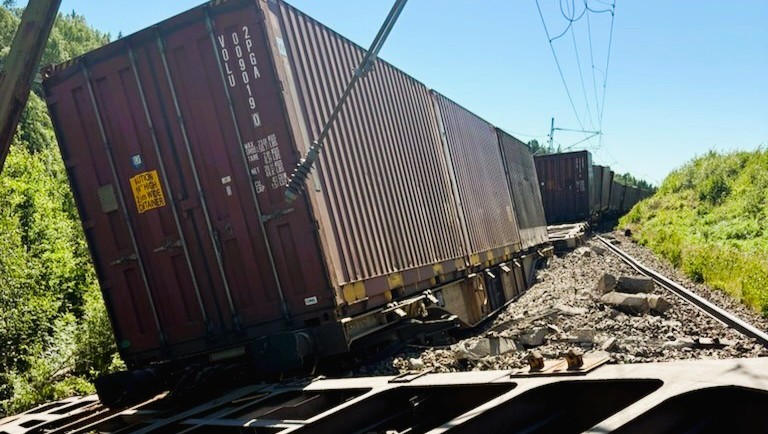
Derailment of a freight train in Bollebygd, Sweden, in June 2026 - Image: Christian Wahlberg, Infranord AB
A similar deformation also led to a serious accident in Canada in early July. Near the city of Repentigny in the province of Quebec, a freight train almost 3.5 kilometers long and consisting of 172 cars derailed; according to Canadian National Railway, 46 cars left the track. Heat-related disruptions and operating restrictions were also reported in the United States, Japan and Australia, as well as in numerous European countries.
Weather conditions turned the past few months into a summer of records across large parts of the Northern Hemisphere. Temperature records were broken in many countries, often in measurement series stretching back more than a century. And studies show that as temperatures rise, so does the risk of track buckling.
Heat puts rails under pressure
“Heat puts the track under pressure,” says Stefan Distlberger, engineer and Head of Business Development at rail technology company Vossloh. In direct sunlight, rails can become around 20°C hotter than the surrounding air. In continuously welded track, this can generate substantial longitudinal compressive forces.
“If the track’s lateral resistance — provided, for example, by the ballast, ties and fastening systems — is no longer sufficient, the track can buckle sideways,” Distlberger explains. “That is when a track buckle occurs.”
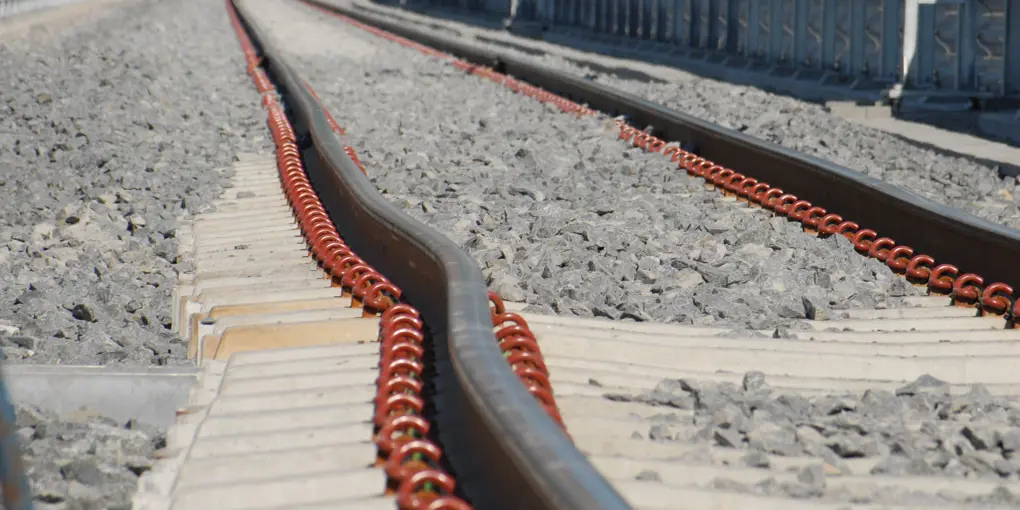
A track buckle, Swedish "solkurva" - Image: Trafikverket
The forces involved are substantial. For one rail profile examined by the Transportation Safety Board of Canada, or TSB, an increase in rail temperature of only around half a degree Celsius generated roughly one additional metric ton of longitudinal compressive force. At 15.5°C above the rail’s stress-free temperature, the compressive force in each individual rail rises to around 28 metric tons.
High temperatures alone do not necessarily cause track buckling. Conditions can become critical when a train passes over a section of track that is already under significant stress: the additional dynamic forces may be enough to cause the track to buckle sideways.
That is why rail operators often impose precautionary speed restrictions during periods of extreme heat. Slower trains place less dynamic stress on the track and therefore reduce the risk of buckling. Once the track has already deformed thermally, however, reducing speed may no longer be enough. In that case, the line may have to be closed and the track repaired.
Dozens of factors interact
“Heat and pressure do not automatically lead to problems,” says Distlberger. “A track buckle occurs where the track offers the least lateral resistance.”
In Lewes, for example, investigators are examining whether prolonged drought may have caused movement in the clay-rich ground and thereby altered the track geometry. In Canada, investigators found missing or displaced rail anchors after the Repentigny derailment — components designed to prevent longitudinal movement of the rail. And in Bollebygd, investigators are still examining which factors, in addition to heat, contributed to the suspected track buckle.
Today, those weak points can increasingly be identified digitally, says Distlberger. Vossloh’s Track Stability software combines information about track design and condition with measurements from inspection runs and visual findings.
“Depending on the line, 30 to 40 factors influence the result,” he says. “These include the design of the track superstructure and substructure, operating parameters such as axle load and speed, and the condition of individual components.”
For selected locations, the software calculates the safety margin against track buckling and determines the temperatures and speeds at which critical thresholds are reached. The margin is expressed as a temperature difference in Kelvin; a difference of one Kelvin corresponds to one degree Celsius. A color-coded map shows where the track is stable and where closer inspection may be required.
The diagnosis can then be translated into specific recommendations: tamping the ballast, installing additional tie anchors, using more robust fastening systems, applying a lighter coating to the rails, or temporarily reducing train speeds.

Stefan Distlberger, Head of Business Development at Vossloh
Increasing the safety margin
Distlberger gives a concrete example: “If we calculate the values for this older fastening configuration on a wooden sleeper, we get a safety margin of 81 Kelvin.” Replacing it with a modern fastening system on a concrete tie increases resistance by 45 Kelvin, raising the margin to 126 Kelvin. “Same curve, same radius — but more than 50 percent more margin before reaching the buckling risk threshold, simply by changing the fastening configuration.”
The software also allows different options to be compared in advance through simulation.
“We can not only identify where a risk is emerging, but also calculate which measure will increase stability most effectively,” says Distlberger.
For infrastructure managers, this means they can focus resources on the locations that are genuinely critical and apply operating restrictions more selectively. That improves network safety and availability while helping to avoid unnecessary interventions and costs.
“Instead of slowing down an entire line as a precaution during extreme heat, speeds can be reduced only where it is actually necessary,” says Distlberger.
Looking ahead, reliable evidence of track stability could also help make maintenance work possible during the height of summer in situations where today’s regulations would not permit it.
How relevant such calculated safety margins can be in practice became clear shortly after the Lewes accident. Just days after the line reopened, service near Lewes was temporarily restricted again for a precautionary track inspection; another inspection followed two days later. Network Rail subsequently said that the record-hot and dry summer had affected track conditions on parts of the route, resulting in speed restrictions and a reduced timetable that remained in place for several weeks.
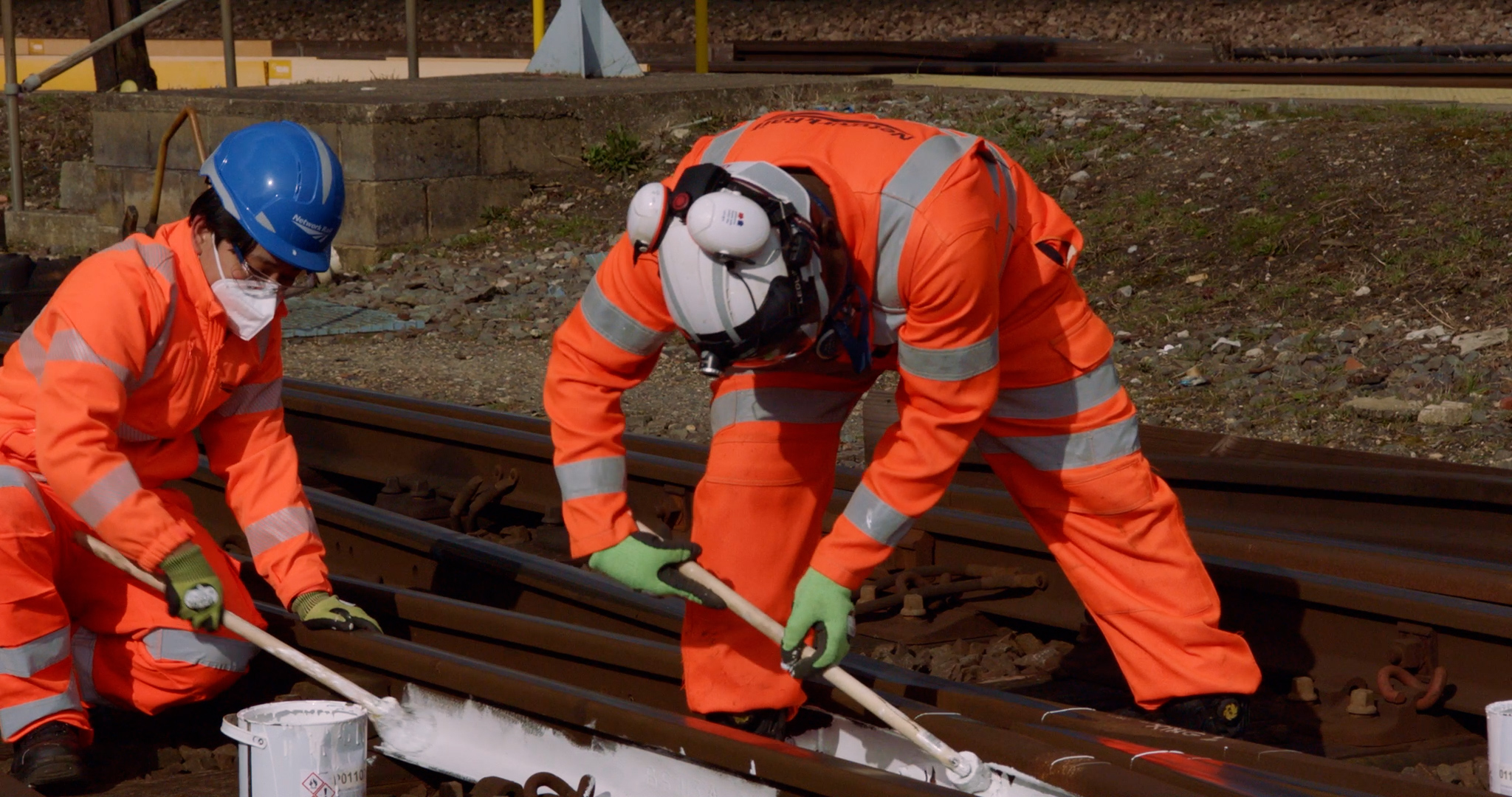
Precautionary measure: Network Rail paints critical sections of railway tracks white during spring to reflect sunlight and lower steel temperatures. - Image: Network Rail