As the world eagerly follows the emotional highlights and shares the thrill with athletes in races decided by hundredths of a second, the Winter Games in the alpine terrain of northern Italy– with its narrow valleys and limited traffic space – are regarded as a stress test for traffic flows, infrastructure, and straightforward usability in everyday life as well as under exceptional conditions. To relieve pressure on roads and sensitive natural areas and to reduce motorized individual traffic on the one hand, and to better integrate the northern provinces into the European rail network on the other, the expansion of public transport as well as cross-border rail connections is being consistently advanced.
Milan also implemented extensive infrastructural measures in the context of the Olympic Winter Games 2026 – focusing on sustainability and improved transport connectivity. The centerpiece of urban development is the decommissioned Porta Romana rail yard. During the Games it accommodates around 1,500 athletes – afterwards the Olympic Village will be converted into student housing and affordable living space. As the main transport hub between the Alps and the Po Valley, the capital of Lombardy is closely interconnected – through dense rail services and the expansion of public transport (such as the RegioExpress to Bolzano) – and as a metropolitan city with the surrounding provinces of Monza and Brianza, Bergamo, Brescia, and Como. The Games act as a catalyst for expanding road and rail networks in Northern Italy – with the goal of shortening travel times. And in Milan itself, public transport was further expanded – including extended operating hours until 2 a.m.

Integrative cooperation on the rails
Milan's local public transport system is characterized by a strong focus on rail. Thanks to a clear infrastructural focus on seamless connections, capacity, and hub integration, the Lombard capital has found a distinctive way to combine a historic tram network with one of Europe’s most advanced driverless metro systems – and, through the Passante, to create an exceptionally efficient link between the surrounding region and the city center.
- The underground connection network: at the core of the unusually strong integration of regional and urban transport on the same infrastructure is the operationally demanding and highly efficient Il Passante Ferroviario di Milano. This underground connecting line runs through the city center, linking several suburban and regional railway lines from the northwest to the southeast. The Servizio ferroviario suburbano di Milano provides fast, high-frequency, commuter-friendly local transport from the outlying areas. Thirteen lines cover the greater Milan area within a radius of up to 60 km. This network with 124 stations increases overall capacity, reduces transfers and establishes S‑Bahn‑like service intervals (up to 6 minutes in the central sections) with a strong impact on urban accessibility.
- High frequency and reliability: The technically advanced Metropolitana subway network, with five lines, is closely linked to the suburban railway stations. Particularly noteworthy are the newer M4 and M5 lines, which are fully automated and driverless, with the hub stations—Milano Porta Garibaldi and Cadorna—serving as multimodal interfaces between long-distance, regional, and urban transport.Furthermore, Line M4 connects Linate Airport to the city center in just 12 minutes and impresses with high frequency (during peak hours every 75–90 seconds).
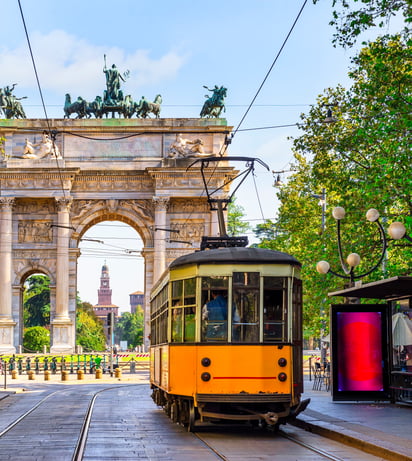
- An extensive tram network: unlike the metro, the tram provides a fine meshed surface level service within the city area. It closes the gaps between metro axes, connects districts without underground access and serves as a feeder to commuter rail stations (particularly along the Passante Ferroviario). Continuously developed, Milan’s tram system combines historic substance with modern urban transport planning and forms a key pillar of the city’s rail‑oriented local transit. With around 160 km of track length, the network ranks among the largest in Italy and is one of the few major European systems that was never fully shut down or heavily reduced. As a result, Milan still has a dense, largely area‑wide tram network in the inner city, with 18 lines operating from early morning until late at night (around 04:30 to 02:30) and connecting the city center with the outer districts.
ATM (Azienda Trasporti Milanesi) pursues the following objectives with its measures to further enhance the efficiency of public transport:
- High connectivity & accessibility: to optimally cover an area with over 3.3 million inhabitants, metro, suburban rail and tram systems have been integrated into a unified network structure. New stations, such as Dateo or Forlanini on Line M4, have been directly integrated into the suburban rail network.In addition, Metropolitana di Milano is planning extensive expansions: the most strategically important project is the extension of Line M5 by about 13 km northwards to Monza (plus eleven new stations). Moreover, Line M4 – completed in October 2024 and connecting Linate Airport with the city center – is planned to be extended further east to Segrate.
- Sustainability & technology: new lines such as M4 use modern technologies, including enhanced safety standards with platform doors that open automatically. In addition, increasing use is being made of slab track with elastic rail fastenings to reduce noise.
- Intelligent infrastructure maintenance: In order to address wear and noise issues in a timely and proactive manner, ATM relies on regular condition assessments of the track and integrated data processing.

The path to quiet and accessible railways
An essential component of rail maintenance in Milan at night is the smart HSG-city. Building on regularly scheduled grinding campaigns for targeted corrugation removal and reliable noise reduction in the tram network, cooperation with the smart advanced version of the compact grinding machine has been expanded and intensified in 2022. The customer immediately recognized the potential of the smart maintenance approach as a symbiosis of surveying, data processing, visualization, and precise implementation:
- Keeping track: both the tram and metro networks are quite large, with more than 100 km of double track. Measurement runs of 20 to 30 km per shift supplement and update measurement results collected by ATM itself and enable condensed use of the findings obtained.
- Development of a preventive grinding strategy: Based on detailed knowledge of the track condition, maintenance measures can be planned and controlled more proactively in both networks.
- More efficient use of budgets with simultaneously increased network availability through well founded maintenance decisions.
- Building a fault history: by collecting track condition data on a quarterly basis, medium term wear developments can be predicted.

For Vossloh, this provided the opportunity to extensively test both the new contactless optical measuring system with laser triangulation sensors on the smart HSG‑city and the evaluation and implementation of the collected data in mapl‑e. In addition, it was necessary to refine the algorithms developed, which generate specific recommendations for action based on the data collected. At the same time, it was important to understand what information operators really need about the condition of their tracks and how the data can be made available or processed in the simplest way possible.
Precise data collection for targeted processing
In order to utilize the special characteristics of the high-speed grinding process during condition assessment, measurements are taken using laser triangulation sensors. In addition to a complete cross‑section profile analysis (rail head deviation and wear), ATM also requested measurement of groove depth in the tram network. The smart HSG city also determines the longitudinal profile (corrugation) and the track gauge. All status data is recorded and localized with meter-level accuracy. When the measurement is triggered, the distance meter starts. Global navigation satellite systems (GNSS) also support positioning.
Several offset laser sensors record the condition of the rails and track.

The pictures on the outside illustrate the before-and-after effect of the grinding process.

Partnership for the long haul
Initially, the focus of the measurement and grinding campaigns was still on the tram network. But the smart HSG-city quickly became "at home" in the metro network as well. Hot spot campaigns are currently underway in the bends. Each grinding run is precisely adapted to the previously measured track condition, ensuring that corrugations are reliably removed and minor profile corrections are carried out with different grinding passes in the recorded sections. Finally, the remaining cross-section is measured.
Careful placement by crane before speeding through the tubes.

ATM benefits from efficient shift planning, resource‑saving processes, and a preventive approach to combating rail noise. When the first trains set off in the early morning at minute‑intervals, a reliable rail infrastructure in peak condition is essential.
The more measurement data from the track flows back into planning, and the more assistance functions condense the significance of the results, the faster cyclical maintenance intervals evolve into a continuous optimization process. Instead of reacting, decisive action is taken. For punctual trains running on quiet rails.
Milan demonstrates impressively how tradition and modernity can interact in the field of sustainable mobility. In Milan, "high-performance sport" does not only take place in sports arenas.