Vossloh connect

Pulsar

AI-Driven Monitoring of freight wagons to optimize your processes and Infrastructure Management Problem description

Operators of rail infrastructure, ports, terminals and industrial facilities face the challenge of maintaining a reliable overview at all times of what is actually happening on their infrastructure. It is often unclear which trains are currently on which section of track, whether train lengths and speeds are being adhered to, or to what extent the route is being used by damaged wagons. This lack of transparency makes it difficult to ensure safe, efficient, and compliant operations.  

In ports, terminals, and industrial facilities, there is a lack of end-to-end transparency regarding all incoming trains and their wagons. Inbound processing is often done manually, which is time-consuming and prone to errors. In particular, the identification of freight wagons and knowledge of the actual wagon sequences are often available only to a limited extent or with delays. This leads to increased search and shunting efforts, longer turnaround times, and higher process costs. 

A lack of information about the condition of the wagon also leads to operational constraints. Without records the wagon condition, there is a risk during loading and unloading that damaged wagon will be loaded again, resulting in avoidable additional costs and delays. Furthermore, efficiently forming new train sets becomes more difficult when information about the technical condition of the wagon is not transparently available. In addition, it is difficult to determine liability.

Because of the increased data transparency provided by the Pulsar, processes can be accelerated, defective wagons can be sorted out early on, and unjustified liability claims can be defended against.
Solution

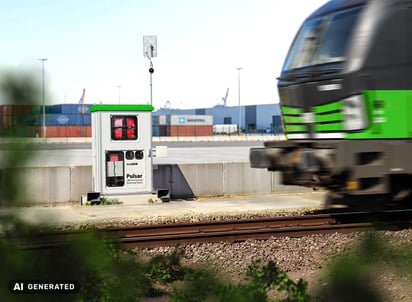
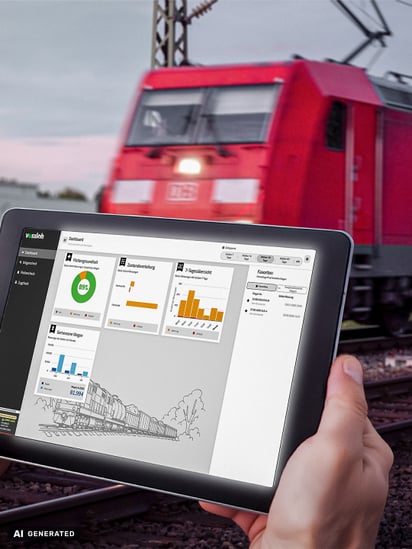
The Pulsar is an innovative AI-driven wayside monitoring system based on various sensor technologies. Equipped with high-resolution cameras, high-performance microphones, and an RFID reader, its compact housing allows for easy installation alongside the infrastructure. The collected data is delivered via an portal or interface.  

How it works

UIC-Number Recognition

Recognition of the UIC-Wagonnumber supports the identification and assignment of the respective wagon, thereby facilitating storage time management.

Wagon sequence

The exact sequence of wagons in the train simplifies handling processes by matching it to the wagon list.

Hazardous Goods

The detection of the hazard indification panel provides information on wheter hazardous goods are being transported on the freight wagon. In addition to the hazard indification number and the UN number, information about the transported substance and the associated hazard is also provided.

Exterior Views

High-resolution wagon images allowing to check for external damages, for further processing of the wagons.

Brake block

The information on brake block thickness in millimeters, supplemented by images of the brakes, provides a clear picture of the brakes’ current condition. This makes it easy to quickly determine whether maintenance is required. At the same time, this data forms the basis for predictive maintenance..

Wheelset damage

Information about suspected wheelset damage (such as wheel flats, material build- up or spalling) supports maintenance planning and provides early warning that damaged freight wagons are operating on the rail infrastructure.

Thermal image

Thermal imaging data makes thermal anomalies in the area of the wheel visible. This allows you to detect hot axle bearings and seized brakes.

Hardware

By using 200 images per second, the Pulsar captures passing freight wagons, whose data is then analysed using computer vision and AI processes. In addition to important process data such as UIC wagon numbers, wagon sequence and external views, we also record condition data such as brake blocks, wheelset damage, hazardous goods and graffiti.

The Pulsar can be set up within one to two days without the need for authorisation or installations in or above the track. They are placed up to a maximum distance of 8 metres from the track and can detect trains at full speed of up to 200 km/h.

A standard power connection is all that is required for technical operation. Data is typically transmitted to the cloud via LTE or 5G connections.


  • Quick setup

Set up within 1-2 days.

  • Simple installation

Only a standard power connection is required for operation.

  • No authorisation effort

No intervention in and above the track necessary.

  • Data transmission

Data can be transmitted via internet connection, LTE or 5G.


Available in various models and with respective add-ons depending on the application.

WhitepaperOverview and data sheet

Contact
Till Mancke
Contact us