

overlay

RTI

Automated NDT inspection from capture to decision

Subjective, inconsistent rail flaw detectionProblem description

Conventional rail testing methods often rely on subjective analysis that limits consistency and efficiency in detecting internal flaws and surface defects. Engineering and maintenance teams need a faster, more repeatable way to capture rail condition data and turn it into maintenance decisions without depending on manual interpretation.
Automated NDT inspection from capture to decisionOur Solution

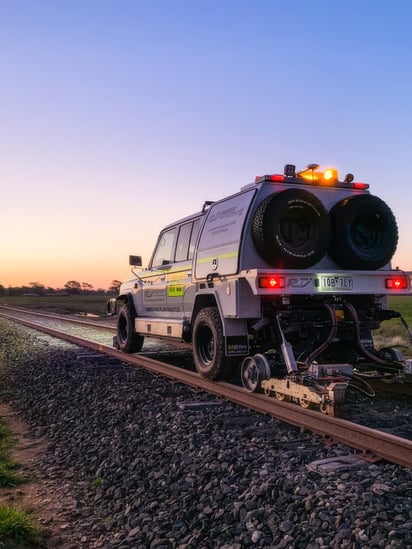
RTI equips hi-rail, rail-bound or push-trolley platforms with automated NDT systems that can be fitted to a wide range of vehicle types, so a single vehicle and operator can capture ultrasonic and magnetic surface data directly from the network. AI-based analysis removes subjectivity from the decision-making process, allowing rail surfaces and internal flaws to be analysed faster and more efficiently with greater consistency and repeatability. Results are then organized in SmartMaps, a visual, map-based infrastructure database built to support track maintenance decisions.

Main features

Advanced Ultrasonic Rail Flaw Detection

Uses proprietary 8800SX technology to detect and assess internal rail flaws.

High-Resolution Rail Surface Mapping

SurfaceMap captures 30 high-resolution digital magnetic signatures across the rail head, including the gauge corner, at 1 mm intervals.

High-Density Data Acquisition

Collects close to 20,000 samples per frame, channel, and rail for detailed rail condition analysis.

AI-Assisted Defect Analysis

Reduces subjectivity in the assessment of internal flaws and rail surface conditions.

Map-Based Infrastructure Database

SmartMaps consolidates inspection results into a visual, map-based platform to support maintenance decisions.

Rapid and Flexible Deployment

Enables setup, calibration, and data collection within approximately 60 seconds. Its compact design supports installation on 4×4, hi-rail, rail-bound, and push-trolley platforms.

Run-to-Run Defect Tracking

Continuously tracks suspected defects over time to support preventive maintenance and condition monitoring.

Additional features

  • One machine, one operator model, positioned as a more efficient alternative to larger crews
  • Compact hardware suited to remote and harsh operating environments
  • Detection of rolling contact fatigue, surface breaking transverse defects, defective welds, cracks in switches and frogs, welds, rail ends, insulated rail joints, squats, engine burns, hunting, track pumping and low level corrugations via SurfaceMap

Let’s move rail infrastructure forward

Would you like to learn more about our digital solutions or discuss a specific infrastructure challenge? Our team will help you identify the right technologies, services and applications for your requirements.

Stefan Distlberger

Head of Business Development Digitalization

Mobile: +49 1525 1652417

Contact
Contact us