Connecting China, changing everyday life
How China built the world’s largest high-speed rail network in less than two decades – and how Vossloh was there from the start
Story | 11/19/2026
China at high speed

Story | 11/19/2026
China at high speed
Story | 11/19/2026
China at high speed
How China built the world’s largest high-speed rail network in less than two decades – and how Vossloh was there from the start

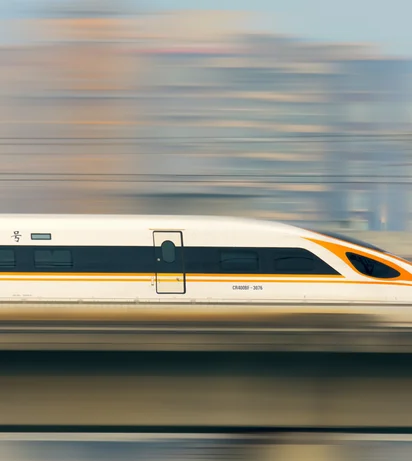
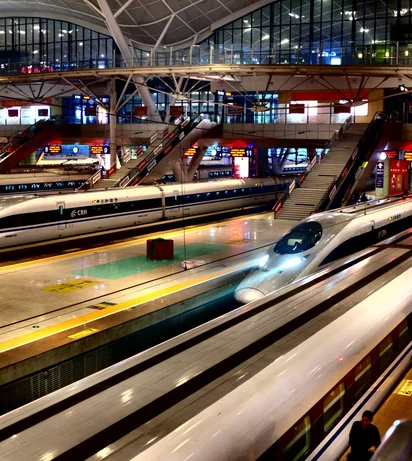
The 22nd century begins in China on August 1, 2008. On that day, the new high-speed rail link between Beijing and Tianjin enters service. Among the curious passengers and foreign visitors eager to try out the new railway just days before the start of the Olympic Games is David Feng. Feng, a Swiss national born in China, boards the train at Beijing Nan Zhan, the newly opened Beijing South Railway Station.
What follows leaves a lasting impression on the rail enthusiast. On the way to Tianjin, the train accelerates to 348 kilometers per hour. After about half an hour, it has covered the nearly 120-kilometer distance. Feng later describes the experience as being “like stepping into the 22nd century.”
Train attendant Xu Ying also recalls how unfamiliar the new speed was to passengers at the time. Many did not remain in their seats but walked through the cars, looked out of the windows and watched the speed display with fascination. Some excitedly asked the train crew to take souvenir photos. In 2008, China’s first railway line built specifically for modern high-speed rail was still a sensation.
The sensation becomes everyday life
Ten years later, Xu Ying observed a very different scene: passengers were reading, looking at their smartphones or sleeping. What had once been a sensation had become part of everyday life.
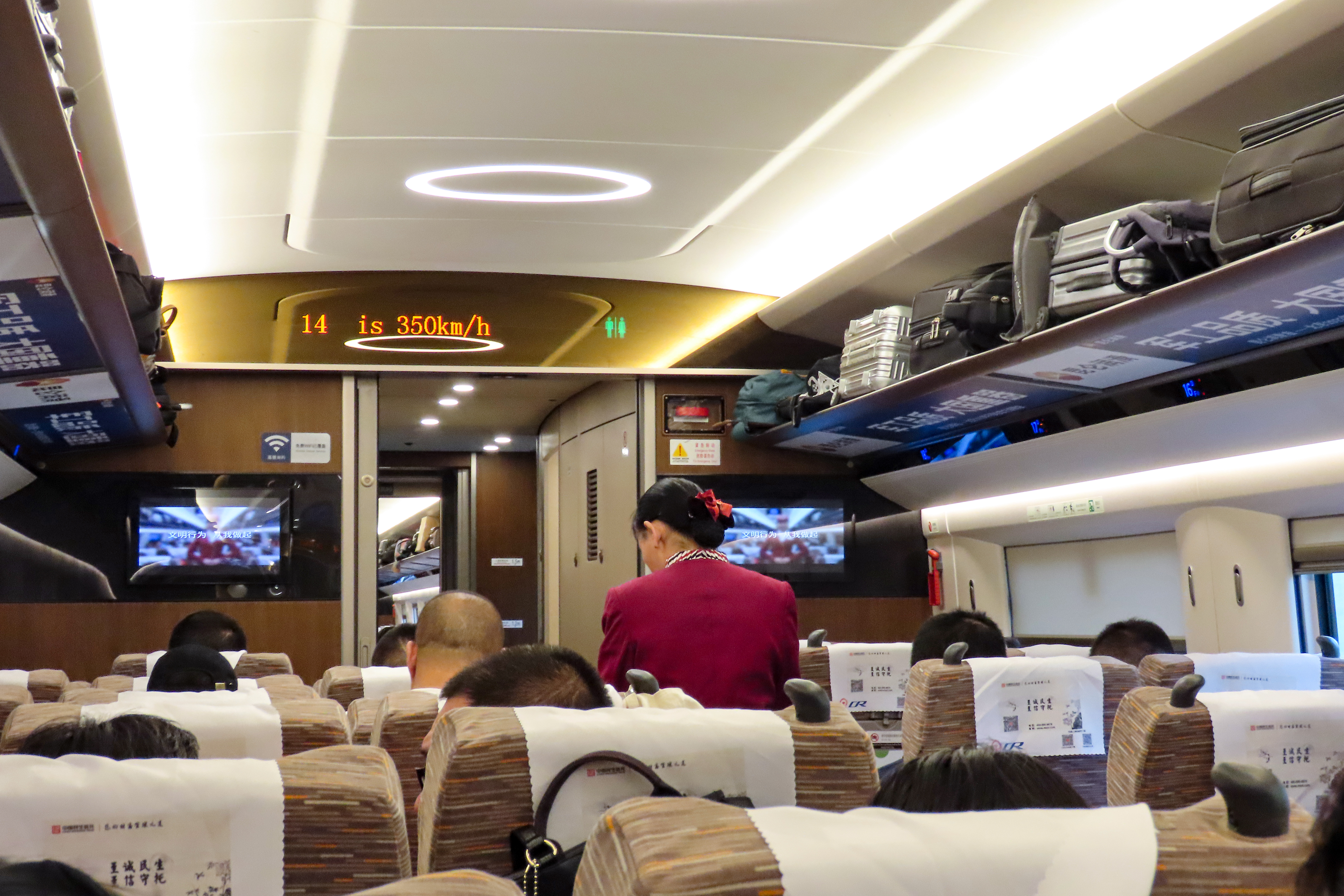
Image: Wikimedia Commons
The nearly 120 kilometers between Beijing and Tianjin were only the beginning. Within just a few years, a single line grew into a national network, initially along major north-south and east-west corridors and later increasingly interconnected by regional corridors and intercity links. Today, China’s high-speed rail network extends for more than 50,000 kilometers – well over the distance around the globe, and more than in any other country.
“Even back then, it was clear that this was not simply about building one new railway line after another,” Eckhard Köppen recalls. “There was a long-term plan for an entire network behind it – and the determination to implement that plan step by step. That pace and consistency impressed me from the very beginning.”
Köppen helped shape those early years for rail technology company Vossloh. As early as 2006, Vossloh received its first major orders for rail fastening systems for the new high-speed lines between Beijing and Tianjin and between Wuhan and Guangzhou. That same year, Vossloh Fastening Systems China was established in Kunshan near Shanghai, with production starting in 2007.
The technical requirements were demanding. At speeds of up to 350 kilometers per hour, rail fastening systems must absorb high dynamic loads while keeping the rail precisely in position over the long term. On slab track, which is widely used in high-speed rail, the elastic components of the fastening system also play an important role in cushioning and distributing the forces that occur.
“In China, people think long term”
Eckhard Köppen helped build up the Kunshan site, later lived in China for 13 years and headed Vossloh’s business there. Kunshan grew with the network – and with its technical requirements: production capacities were expanded, new technologies introduced and an increasing number of projects supplied.
At the same time, Vossloh’s activities became broader. In Wuhu, a joint venture for turnout production began operations in 2012. One year later, Vossloh’s High Speed Grinding technology was used for the first time on the Beijing–Shanghai line. Developed by Vossloh, the technology makes it possible to treat rails preventively at speeds of up to 80 kilometers per hour, before minor surface damage develops into larger defects.
“In China, people think long term,” says Köppen. “With a network of this scale, the question of how to keep the infrastructure performing reliably over the long term is part of the equation from the very beginning. Preventive maintenance is therefore part of a holistic approach to preserving value and ensuring availability.”
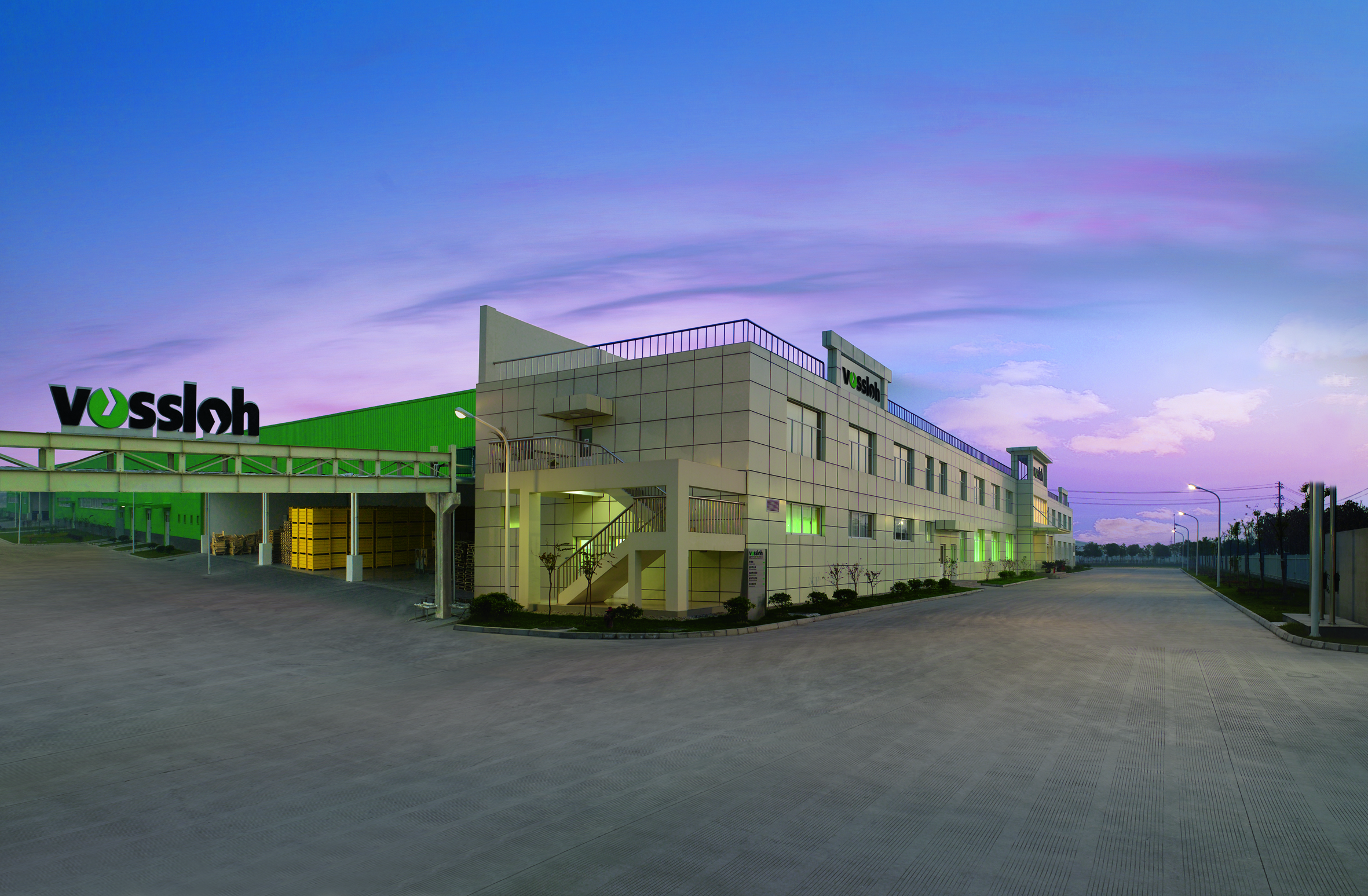
Vossloh plant in Kunshan
From supplier to partner
In 2015, Vossloh also established its own Rail Services company in Kunshan. In the years that followed, more and more manufacturing and service activities were localized. Today, High Speed Grinding is used by twelve of China’s 18 regional railway administrations. Vossloh’s role has evolved accordingly: from supplying individual components to being a partner supporting the Chinese rail system throughout its entire lifecycle.
At the same time, the service portfolio has continued to broaden. In addition to High Speed Grinding on long-distance and high-speed lines, Vossloh now also deploys the smaller HSG-city grinding train for urban rail networks in China as well as the VTM-compact milling machine.
At the beginning of 2026, the Kunshan plant reached another milestone: 150 million tension clamps had been manufactured there since production began.
“That is, of course, an impressive number,” says Köppen. “But above all, it represents 20 years of work – people who built something here, repeatedly mastered new challenges and turned a young plant into an established site. The Kunshan team has every reason to be proud of that.”
And the development is far from over. While the major national corridors are now firmly established, China continues to make its network denser. New regional links, additional corridors and higher-capacity hubs are intended to further improve accessibility and capacity. Vossloh is also participating in this next phase of expansion, including through new orders for high-speed rail lines in Shandong Province.
Corridors become a network
The development of China’s high-speed rail network followed a long-term plan from the outset. As early as 2004, China’s “Medium and Long-Term Railway Network Plan” defined a basic structure of four north-south and four east-west corridors. The new lines were intended to connect the country’s major economic centers while also relieving existing rail routes: long-distance passengers moved to the new high-speed trains, freeing additional capacity for freight traffic on conventional lines.
After Beijing–Tianjin opened in 2008, the major corridors followed in rapid succession. The Wuhan–Guangzhou line entered service at the end of 2009, followed by Beijing–Shanghai in 2011. By the end of 2012, the more than 2,000-kilometer high-speed link from Beijing to Guangzhou was also fully operational. Individual showcase projects were beginning to form a nationwide network.
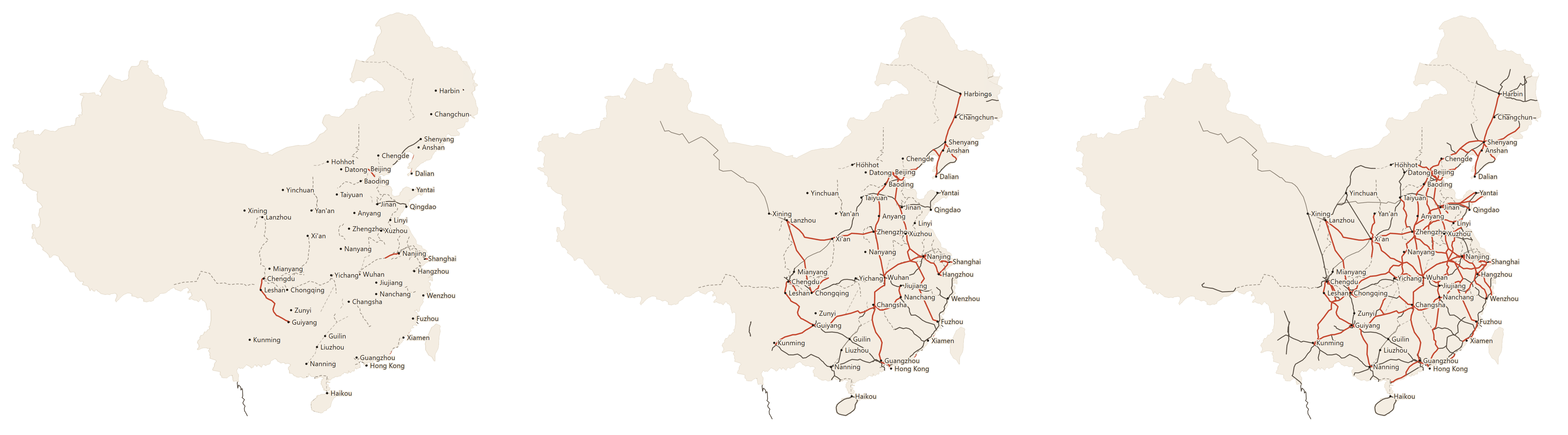
China’s high-speed network 2008, 2017, and 2026 | Image: Chinerary
The Wenzhou turning point
The expansion was not without setbacks. On July 23, 2011, a serious accident occurred near Wenzhou in Zhejiang Province. An express train rear-ended another train ahead of it. Forty people were killed and 172 injured.
The accident became a turning point for an expansion program that until then had been characterized by extraordinary speed. China reviewed technology, safety procedures and ongoing projects, temporarily suspended approvals for new projects and reduced operating speeds on several lines.
The consequences were also felt immediately in Kunshan. The sleeper plants relevant to Vossloh stopped work on high-speed projects at the end of July 2011. Deliveries of rail fastening systems did not resume until June 2012.
The backbone is in place
The interruption did not, however, mean that China was abandoning its high-speed rail program. Expansion picked up again as early as 2012. And with the revised long-term network plan adopted in 2016, the next stage of development began: the previous system of “four vertical and four horizontal” main corridors was expanded into eight north-south and eight east-west corridors.
These were complemented by additional regional connections and intercity lines. The aim was no longer simply to connect the major metropolitan areas, but to create an increasingly dense network reaching virtually all large and medium-sized cities.
Today, this basic structure has largely become reality. The next phase is therefore increasingly about densification: new cross-links, additional regional corridors and tighter networks within the country’s major economic regions. The national corridors form the backbone, while more and more gaps in between are being closed.
米 – when a Chinese character becomes a network plan
Shandong offers a good example of what the next phase of China’s rail expansion looks like. The eastern Chinese province, home to more than 100 million people, lies between the major economic regions around Beijing and Shanghai and is also home to Qingdao, one of the country’s most important ports.
With the main national corridors now in place, the focus is increasingly on making connections within the province denser, creating new cross-links and linking regional economic areas more closely.
Planners have found a vivid image for this development. Around the provincial capital Jinan, a transportation system is being created whose structure resembles the Chinese character 米 – mǐ, meaning rice. Radial connections extend from Jinan in several directions, complemented by an outer ring. Individual lines are intended to become closely interconnected regional networks in which major cities can be reached increasingly quickly.
At high speed to the birthplace of Confucius
Vossloh is also involved in this next phase of expansion. In the summer of 2026, the company received two new major orders for high-speed rail lines in Shandong.
The Jinan–Zaozhuang line will serve the southern part of the province and passes through Qufu, an important tourist destination and the birthplace of Confucius. A second line connects the Qingdao region with Zhucheng, linking the port city more closely with other economic areas in the province. The fastening systems will once again be manufactured in Kunshan, with deliveries beginning in 2027.
In October, Vossloh celebrated 20 years in Kunshan together with employees, customers, partners, representatives of its fellow shareholders and local authorities. Eckhard Köppen was, of course, there as well.
One special moment of the evening was dedicated to those who have personally helped shape much of this development: 21 employees were honored for five, ten or 15 years of service, while seven more will soon be able to look back on 20 years with Vossloh in Kunshan. For Köppen, these long-standing relationships are an important part of the success story.
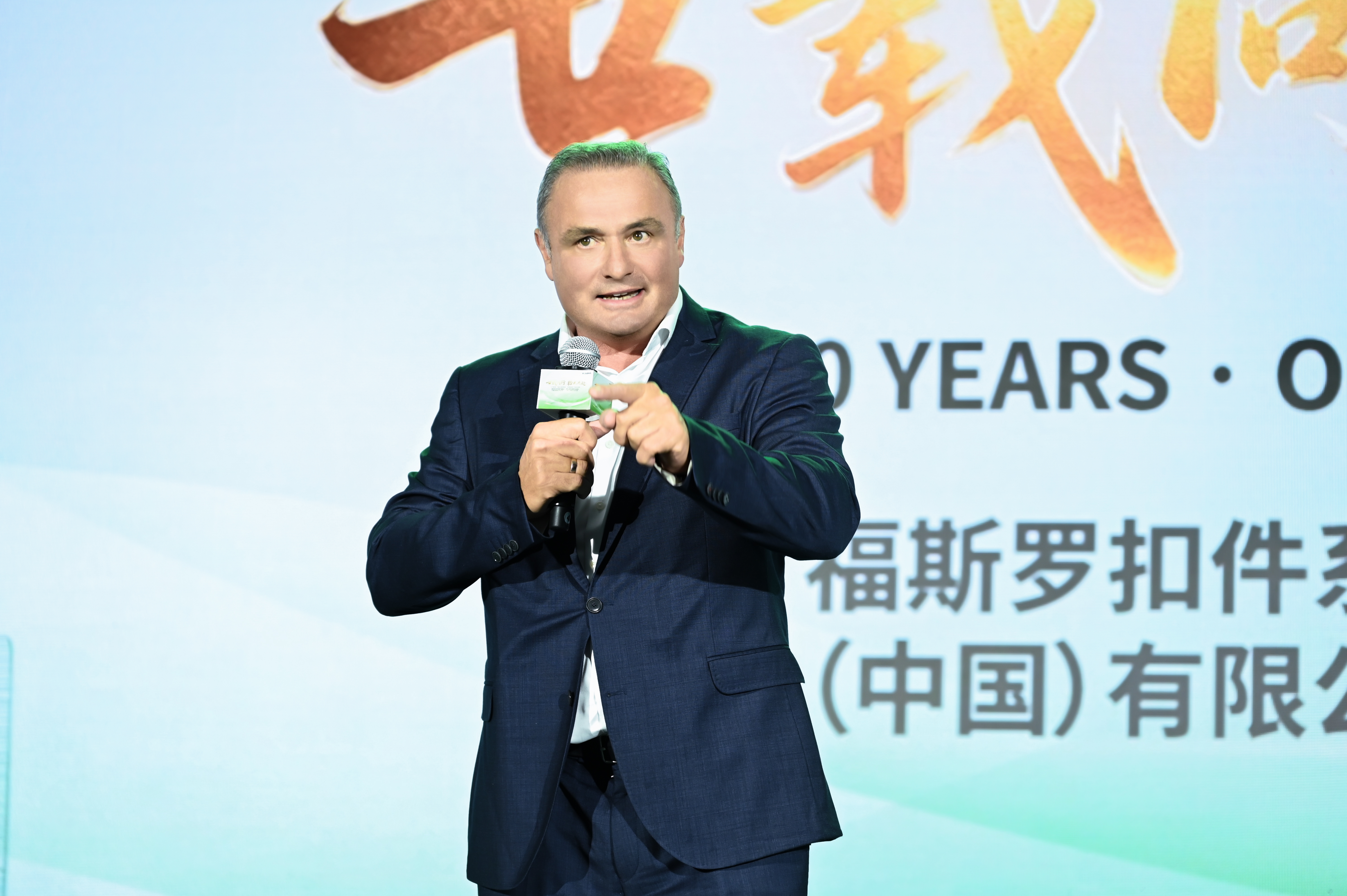
Eckhard Köppen at Vossloh's 20 years celebration on Kunshan
What other countries can learn
Now back in Germany for several years, Köppen would like to see more of the factors behind China’s rail development applied in his own country – above all, its speed.
“I hope we can become faster in Germany and Europe as well,” he says. “We need shorter decision-making processes and faster implementation.”
From a Western perspective, the strong role of the state in China’s economy is frequently a subject of criticism. Yet when it comes to developing the high-speed rail network, international observers also identify this as an important factor behind its success. The World Bank highlights in particular long-term planning, consistent implementation, standardized technical specifications and close coordination between the central government and the provinces. The result: large parts of the network were built in an unusually short period of time and at comparatively low cost.
The overall picture also includes challenges. Not every line achieves the utilization levels of the major corridors, and the rail system’s high level of debt continues to fuel debate over the economics of further expansion. According to a recent study, around $1 trillion has been invested in building China’s high-speed rail network since 2008.
Almost one billion rail journeys in a single summer
China has certainly succeeded in making rail travel attractive. During the 62-day summer travel season in 2026 alone, Chinese railways recorded 954 million passenger journeys – more than 15 million per day. That was nearly 30 percent more than during the same period in 2019. Around 138 million passengers traveled on domestic flights in China over the same summer. In other words, rail accounted for almost seven times as many passenger journeys.
Trips that once took days can now often be completed in just a few hours. Cities and regions have moved closer together, while business travel and family visits have become easier. That is why David Feng calls it “the people’s railway.”
Feng, the Swiss national who has chronicled the development of China’s railways for many years and who already felt as if he had entered the 22nd century on his first journey from Beijing to Tianjin in 2008, sums up the transformation in an interview with Süddeutsche Zeitung:
“China’s high-speed trains have changed the country.”

The 22nd century begins in China on August 1, 2008. On that day, the new high-speed rail link between Beijing and Tianjin enters service. Among the curious passengers and foreign visitors eager to try out the new railway just days before the start of the Olympic Games is David Feng. Feng, a Swiss national born in China, boards the train at Beijing Nan Zhan, the newly opened Beijing South Railway Station.
What follows leaves a lasting impression on the rail enthusiast. On the way to Tianjin, the train accelerates to 348 kilometers per hour. After about half an hour, it has covered the nearly 120-kilometer distance. Feng later describes the experience as being “like stepping into the 22nd century.”
Train attendant Xu Ying also recalls how unfamiliar the new speed was to passengers at the time. Many did not remain in their seats but walked through the cars, looked out of the windows and watched the speed display with fascination. Some excitedly asked the train crew to take souvenir photos. In 2008, China’s first railway line built specifically for modern high-speed rail was still a sensation.
The sensation becomes everyday life
Ten years later, Xu Ying observed a very different scene: passengers were reading, looking at their smartphones or sleeping. What had once been a sensation had become part of everyday life.

Image: Wikimedia Commons @https://creativecommons.org/licenses/by-sa/4.0/
Sources and further reading:
UIC: High-Speed Rail Atlas 2025, May 2026
International Transport Forum/OECD: Investment in transport infrastructure: Latest global data comparison, July 2026
World Bank: China’s High-Speed Rail Development, June 2019; China’s Evolution in International Standardization: From Follower to Global Leader, October 2025
Yang et al.: The distributional effects of high-speed rail investment in China, September 2026
China State Railway: China’s railway mileage tops 165,000 km, January 2026; China adds 1,625 km of new rail lines amid push to build modern railway infrastructure, October 2026; China’s railways handle about 954 mln passenger trips during summer travel rush, September 2026
China National Development and Reform Commission (in Chinese): Medium and Long-Term Railway Network Plan, July 2016
Shandong Provincial Department of Transport (in Chinese): 14th Five-Year Comprehensive Transport Development Plan, July 2021
Xinhua: All aboard: China’s high-speed rail 10 years on, August 2018
Süddeutsche Zeitung (in German, paywall): Mit 350 Stundenkilometern in die Zukunft, August 2023
Vossloh AG: 150 million tension clamps produced in China, January 2026; Vossloh to deliver high-speed grinding train to China, March 2026; Vossloh wins major contracts in China, July 2026